cryptography
Elliptic Curves
Elliptic-curve cryptography (ECC) protects Bitcoin wallets, HTTPS connections, Signal messages and SSH logins. This section builds up to it one step at a time, starting from the shape the name comes from: the ellipse.
| # | Topic | What it covers | Guide | Live demo |
|---|---|---|---|---|
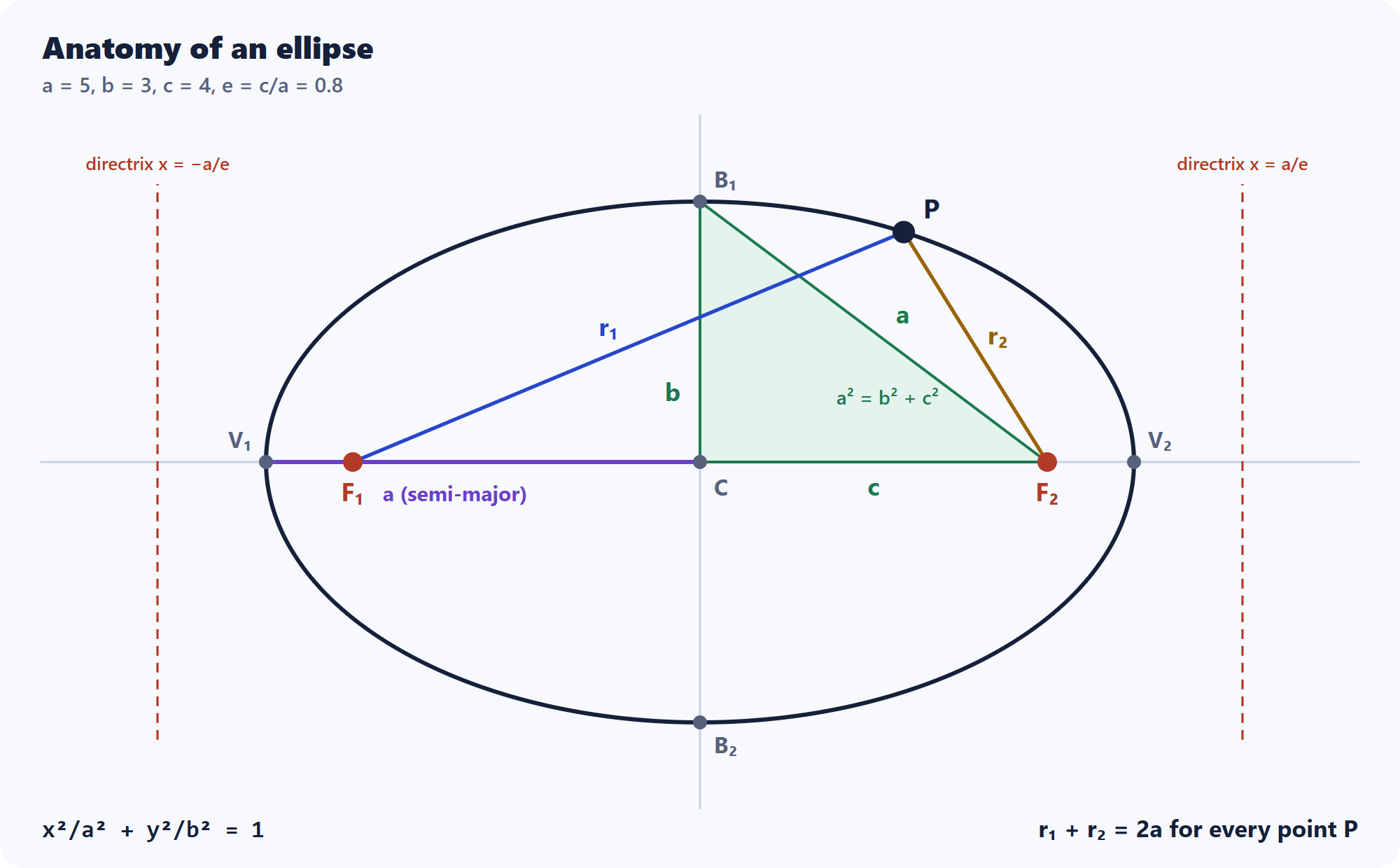
| 1 | Ellipse | Definition, equations, area, perimeter, reflection, Kepler orbits, real-world uses, and how the ellipse led to elliptic curves | README | Open |
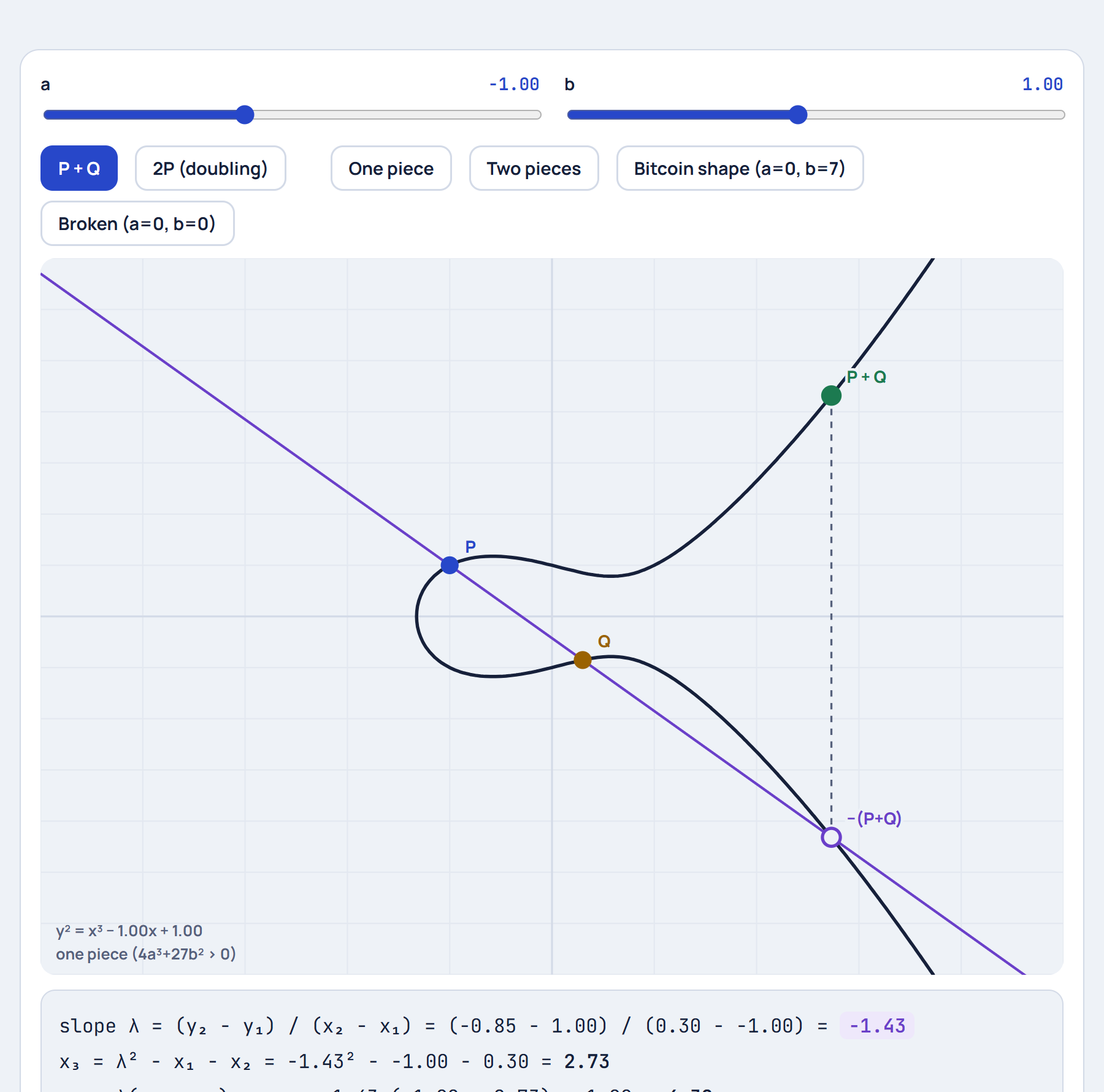
| 2 | Elliptic Curve | What an elliptic curve is, adding points, finite fields, ECDH key exchange, ECDSA, why ECC is used, and an attacker demo | README · Step by step · Real-life example | Open |
| Ellipse | Elliptic curve |
|---|---|
 |
 |
The road to ECC
- Ellipse: a closed curve where r₁ + r₂ = 2a. Its perimeter leads to elliptic integrals.
- Elliptic curves over real numbers: y² = x³ + ax + b, and adding points with the chord-and-tangent rule.
- Elliptic curves over finite fields: the same rule, done with arithmetic modulo a prime p.
- ECC: key exchange (ECDH) and signatures (ECDSA), with security based on the elliptic-curve discrete logarithm problem.
Steps 1–4 are covered by the two projects above: Ellipse for step 1, and Elliptic Curve for steps 2–4.
Folder structure
elliptic-curves/
├── README.md        # This index
├── ellipse/         # Ellipse guide + Ellipse Lab
│   ├── README.md
│   ├── index.html
│   └── images/
└── elliptic-curve/  # Elliptic curve guide + Elliptic Curve Lab
    ├── README.md
    ├── step-by-step.md
    ├── real-life-example.md
    ├── index.html
    └── images/